
Day: July 28, 2026

Dubai , July 28 , 2026 : ​ Blockmaze has set a new benchmark in the global tokenisation market by helping power tokenised access to more than 24,000 stocks through Dealing.com, representing exposure to over US$100 trillion in underlying global equity market value.

The milestone comes as leading global financial institutions accelerate efforts to bring traditional financial assets on chain, from treasuries and private credit to money market funds and equities. Tokenisation is gaining momentum as financial markets look to reduce settlement friction, improve transparency, expand access, and make real-world assets programmable.

Through infrastructure provided by Blockmaze, Dealing.com has enabled tokenised access to 24,000+ stocks across 16 global markets, including the NASDAQ, Singapore Exchange, Tokyo Stock Exchange, London Stock Exchange, Hong Kong Exchange and other major jurisdictions. While several tokenised stock platforms are still focused on hundreds of equities, Blockmaze has helped power a far broader infrastructure-led breakthrough.

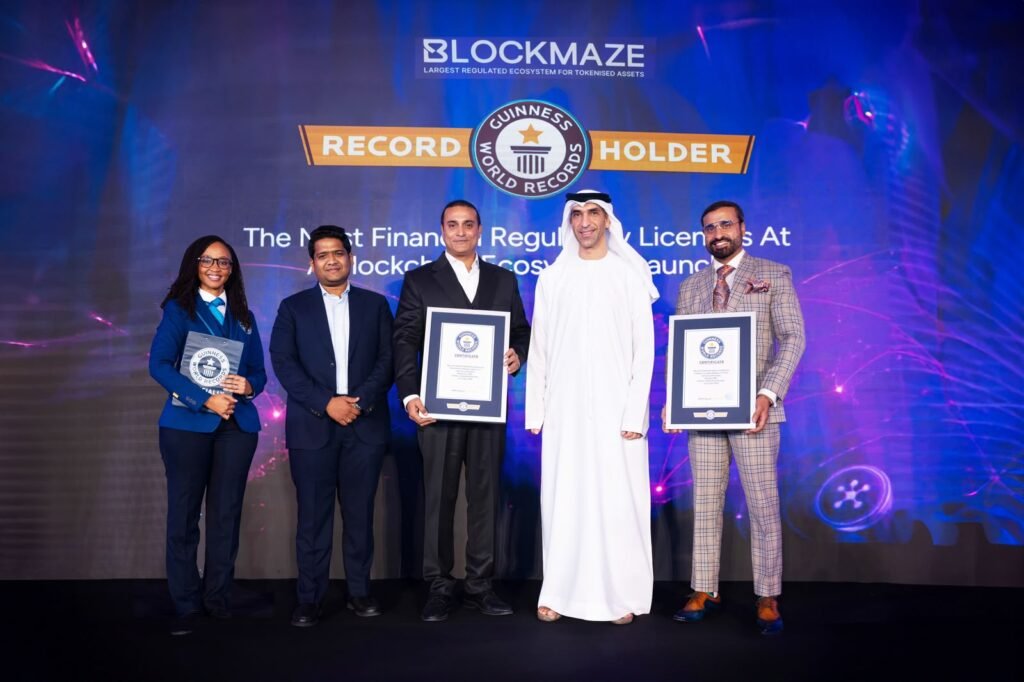
Dealing.com has been awarded the Guinness World Records title for “The Most TokenisedStocks Available for Trading on a Single Platform,” with record verification confirming over 24,000 live, active and publicly available tokenised stocks on the platform. Blockmaze has also received a Guinness World Records title for “The Most Financial Regulatory Licences at a Blockchain Ecosystem Launch,” reinforcing its focus on regulated infrastructure for blockchain-based financial markets.

“Tokenization is not just about putting assets on chain. It is about building the regulatory, technological, and market infrastructure required for real financial assets to move on chain safely. With Blockmaze powering 24,000+ tokenized stocks through Dealing, we are demonstrating that tokenized equities can move beyond pilots and into global-scale market infrastructure,” said Tajinder Virk, Co-Founder & CEO, Blockmaze / Finvasia Group.

The achievement reflects more than a stock count. It highlights the growing importance of regulated infrastructure in tokenised finance, particularly as the market moves beyond experimental products and synthetic price-tracking models.

Many tokenised stock products globally have faced scrutiny over whether users receive only economic exposure or meaningful benefits linked to the underlying equity. Blockmaze aims to address this challenge through infrastructure designed to support tokenised assets connected to the underlying instrument rather than functioning only as synthetic exposure.

The tokenised stocks available through Dealing and powered by Blockmaze infrastructure are designed to reflect benefits linked to the underlying equity. This includes dividend treatment where applicable, adjustments for stock splits, and economic treatment connected to mergers, acquisitions, restructuring or other corporate actions.

Blockmaze’s approach is built around the belief that tokenisation cannot scale without regulation. The market has already seen examples of tokenised stock products being discontinued after regulatory scrutiny, underlining the need for compliant issuance, custody, payments, trading infrastructure and market access rails.

The Blockmaze ecosystem brings together a multi-jurisdiction regulatory foundation across key financial markets, supported by licences, registrations and regulated entities within the wider Finvasia ecosystem. This enables institutions, brokers and platforms to launch tokenised assets on infrastructure designed for compliance from day one.

“Global markets cannot move on chain through technology alone, they require regulated entities, verified issuers, compliant custody, transparent settlement and the ability to manage real-world asset events such as dividends, stock splits and corporate actions. Blockmaze has been built to bring these layers together, so institutions can launch tokenised assets with the confidence, controls and market discipline expected in traditional finance,” said Virk.

Alongside its regulatory foundation, Blockmaze is built as infrastructure for regulated real-world assets rather than a generic blockchain attempting to retrofit compliance later. Its technology stack is designed around issuance, compliance, verification and settlement.

The platform provides blockchain infrastructure on which regulated real-world assets can be issued, transferred, managed and verified. Tokenised assets on Blockmaze are designed to be issued by verified entities, regulated participants and approved asset structures, supporting issuer accountability and helping protect the ecosystem from fake, duplicate or unauthorised tokenisedassets.

Blockmaze’s compliance-first token standards are designed to support regulated financial assets, including issuer controls, whitelisting, transfer restrictions, KYC and KYB compatibility, corporate action support, auditability and lifecycle management. The infrastructure also supports audit trails, issuer-level verification and transparent records for institutions, brokers, regulators and investors.

The ability to handle real-world asset lifecycle events will become increasingly important as dividends, stock splits, mergers, delistings and other corporate actions require financial-market-grade infrastructure. Blockmaze is positioning itself as the regulated infrastructure layer capable of supporting these requirements at global scale.

By powering access to 24,000+ tokenised stocks through Dealing, Blockmaze is demonstrating how regulated blockchain infrastructure can help move tokenised equities from limited pilots into real market deployment, opening a new chapter for global investing and real-world asset tokenisation. 
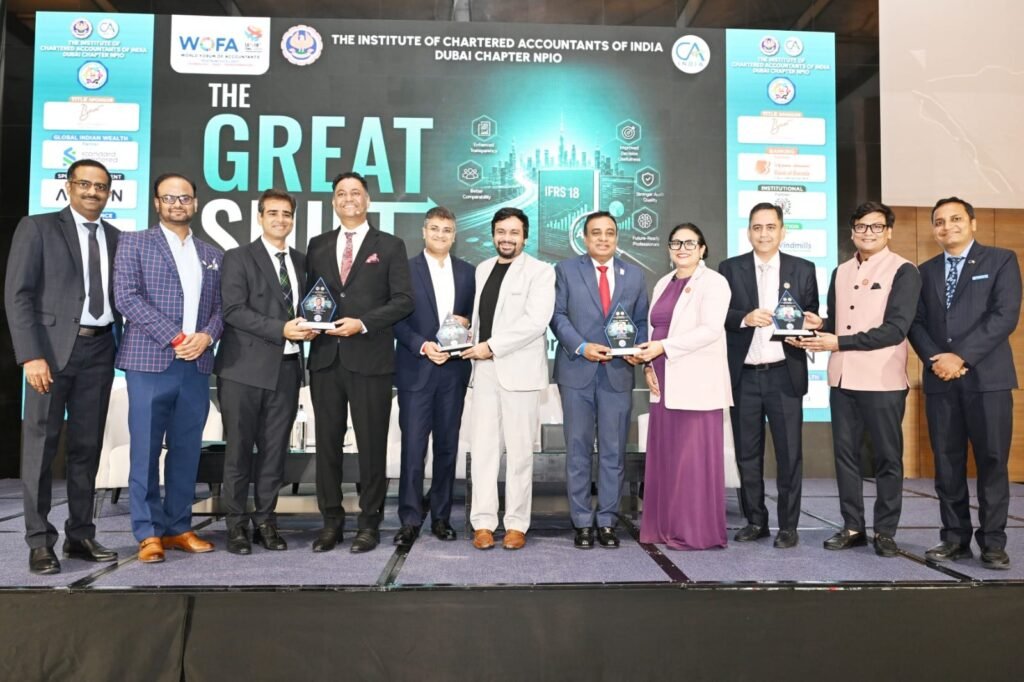
Dubai , July 28 , 2026 : Artificial Intelligence is going to change the global accounting, auditing and assurance business by speeding up the process with increased accuracy, ensuring compliance and better governance, officials told more than 400 accounting professionals at a conference titled: The Great Shift towards IFRS18 – The Future of Audit, organised by the Dubai Chapter of the Institute of Chartered Accountants of India (ICAI).

The global accounting and auditing market is valued at US$254.36 billion in 2026, driven by a 6.1 percent growth rate. Market research reports from groups like The Business Research Company show steady financial expansion across corporate sectors. 

“Accounting and auditing professions have been supported and guided by technology for some time with new software systems. However, the future of our industry will be shaped and powered by innovation and Artificial Intelligence (AI) – as it is the future,” CA Rishi Chawla, Chairman of the Dubai Chapter of the ICAI, said in his opening remarks at the conference.

“In a world where information moves faster than ever, trust has become the most valuable currency. As AI and technology reshape the way businesses operate, the future of audit lies in combining innovation with professional judgement to deliver stronger assurance, greater transparency and deeper insight.

“ICAI has always been at the forefront of adoption of technology and innovation and, through this course, our fellow Indian Chartered Accountants will lead the industry once again with speed, accuracy, strong data analytics, increased compliance and governance.”

Padmanabha Acharya, Chairman of Deloitte Middle East, said, “Implementation of AI into operations should have a strategy that includes centralised investment and seamless implementation and integration within the organisation. The company’s leadership should be aware of the risks and opportunities of adoption of AI including governance, compliance, control and biasness. Particularly the governance of AI in accounting and auditing is very crucial.

The conference, attended by more than 400 members of ICAI, featured keynote address and presentation by leading accounting professionals, corporate financial leaders and regulators. The UAEs financial regulators are currently collaborating on information, compliance and governance, officials said.

Talal Samad, Associate Director – Monitoring at the Abu Dhabi Global Markets (ADGM), said, “We are signing up MoUs with other financial and capital market regulators to create synergies in the sector. The whole idea of audit is to protect the assets, shareholders and investment as well as protect the businesses. So, AI should strengthen the process.

“The number of auditing firms under ADGM has accelerated to 60, from 16 a few years ago, due to the higher demand for accounting, bookkeeping, auditing, assurance and tax advisory services. The number is going to grow in the coming years.”

Naweed Lalani, Director, Audit and Infrastructure Supervision, at the Dubai Financial Services Authority (DFSA), said, “As the region’s first independent audit oversight authority, the DFSA has a long-standing commitment to strengthening audit quality and market confidence through effective supervision, innovation, and collaboration. Through enhanced regulatory coordination, almost 97 per cent of the UAE’s capital markets auditors are coming within the scope of closer supervisory cooperation. 

“Joint inspections of firms’ systems of quality management will support supervisory consistency, strengthen regulatory effectiveness, avoid regulatory arbitrage, and build capacity across UAE regulators. Ultimately, these efforts reinforce investor confidence, support the integrity and resilience of the UAE’s capital markets, and help ensure that the audit profession continues to evolve in step with an increasingly digital financial system.”

Experts also discussed the challenges and opportunities of adoption to the new International Financial Reporting Standards (IFRS) 18 that will become mandatory for all financial reporting from January 1, 2027. IFRS 18 is a new accounting standard that replaces IAS 1

Introducing the basic fundamentals of IFRS 18, Firoz Ali Ghadyaly, Principal at KPMG Finance and Accounting Advisory, says, “IFRS 18 introduces four fundamental changes to financial statement presentation and disclosure: a structured statement of profit or loss with mandatory categories, defined operating profit subtotals, enhanced requirements for aggregation and disaggregation of information, and disclosures for Management-defined Performance Measures (MPMs). For the first time, MPMs will form part of the audited financial statements. Together, these requirements will help companies better tell their financial story and strengthen the link between management reporting and statutory financial reporting.”

The biggest IFRS 18 challenge is not preparing the financial statements. It is ensuring that the underlying data, systems, processes, controls and management reporting frameworks are capable of consistently producing IFRS 18-compliant information, he says. The standard will have a significant impact on large organisations and diversified group companies that operate multiple business models, geographies and ERP environments. Determining operating versus investing activities, aligning management reporting with external reporting, and implementing the new aggregation and disaggregation requirements will require substantial changes across finance functions and systems.

“The implementation date of IFRS 18 is now less than six months away. While IFRS 18 does not change how companies recognise or measure transactions, it fundamentally changes how financial performance is presented, analysed and explained to stakeholders. Companies will be required to apply IFRS 18 retrospectively from 1 January 2027, including the restatement of comparative information for FY2026,” he says. 

“Organisations should therefore begin assessing the impact on their chart of accounts, ERP systems, consolidation processes, reporting packages, internal controls and governance frameworks well in advance to ensure a smooth transition.”

James Mathew, CEO and Managing Partner, UHY James Chartered Accountants LLC, says, “We are entering in an era where we have to Control, Shift, Alt and Delete – that means we have to learn, re-learn and unlearn things of the past and reform ourselves by embracing technology and innovation. This is true for both AI and IFRS18 – as both are more focussed on transparency, data analytics and presentation. The quality of data is going to be very crucial for all of us in this profession.”

Priju Dominic, Founding Partner & CEO of Dominic & Partners, says “IFRS 18 is not merely a new reporting standard, it represents a new era in financial communication. By enhancing transparency, comparability and the quality of performance reporting, it enables organisations to tell their financial story with greater clarity and credibility. Early preparation is not just about meeting the implementation deadline rather it is about strengthening stakeholder confidence and creating long-term value.”

With more than 3,200 membersICAI Dubai Chapter is the largest business group in the UAE. Established in 1982, it is also the largest, most active and award-winning chapter among the 44 overseas chapters of ICAI. It has registered a phenomenal growth in membership has exceeded 3,200 members who represent more than 1,550 multinationals and other companies.

Dayaniwas SharmaCentral Council Member of the ICAI, said, “We have trained 36,000 digital-savvy accounting professionals in forensic accounting and more are being trained through different curriculum such as Diploma in Information Systems Audit (DISA). As one of the best accounting institutions, ICAI has already embraced technology, innovation and AI into our practice and we have established an Advanced Forensic Auditing and Technology Lab – a Centre of Excellence – in Hyderabad to provide smaller CA firms access to high-end forensic tools.

“We are currently training them through DISA 4.0 – the most advanced module that requires 8 days of physical learning, 2 days of immersive learning and 16 hours of online learning before certification. As Indian Government is spending trillions of rupees to digitise the country’s economy and business, the accounting and auditing professionals also should prepare to serve a digitalised business environment.” 

ICAI is the largest professional body of Chartered Accountants across the world with over 1,000,000+ students and around 450,000+ members. ICAI has a wide network with five Regional Councils, 176 Branches, 54 Overseas Chapters, and 31 representative offices across the globe. And among 54 overseas chapters, ICAI Dubai Chapter is the largest and most vibrant chapter of ICAI. Of the 8,000 Indian Chartered Accountants active in the UAE‘s private sector, 1,400+ are currently leading businesses in senior positions.